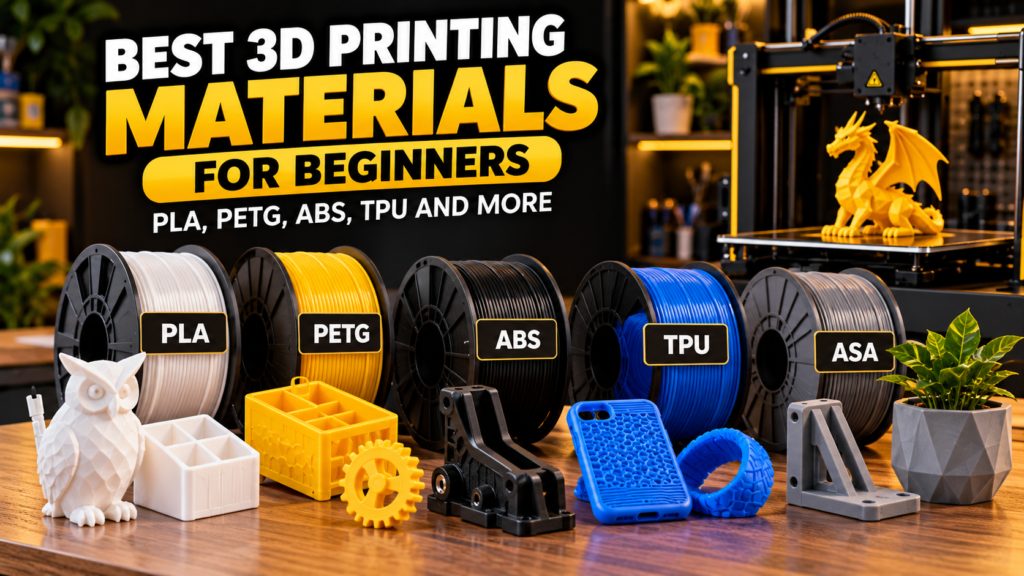
3D printing starts with choosing the right material. Different filaments have different strengths, printing temperatures, flexibility, and ideal uses. For beginners, understanding the most common materials can make printing easier and help prevent failed prints.
In this guide, we’ll look at some of the most popular 3D printing materials and explain when you might want to use each one.
1. PLA
PLA is one of the most popular materials for desktop 3D printing and is often a good starting point for beginners.
It is relatively easy to print, available in many colors, and works well for decorative models, figures, organizers, prototypes, and many everyday projects.
PLA generally requires less demanding print settings than some other common materials, making it useful while you are learning how your printer works.
2. PETG
PETG is another widely used filament. It combines relatively easy printing with better toughness and temperature resistance than standard PLA in many applications.
It can be useful for functional parts, brackets, containers, organizers, and other objects that need more durability.
PETG can sometimes produce stringing during printing, so temperature and retraction settings may need some adjustment.
3. ABS
ABS has been used in 3D printing for many years and can produce strong, durable parts.
However, it is generally more difficult to print than PLA because it is more sensitive to temperature changes and can warp as it cools.
An enclosed printer and appropriate ventilation are often helpful when printing ABS.
4. TPU
TPU is a flexible material that can bend and stretch instead of behaving like a rigid plastic.
It is commonly used for flexible covers, protective parts, feet, grips, straps, and other objects where flexibility is useful.
Because TPU is soft, it can require slower printing speeds and careful printer settings.
5. ASA
ASA is a durable material often considered for parts that may be used outdoors.
It offers good resistance to weather and ultraviolet exposure compared with many standard filaments.
Like ABS, however, ASA can be more challenging to print and benefits from controlled printing conditions and suitable ventilation.
Which Material Should Beginners Choose?
For many beginners, PLA is the simplest place to start. It is widely available, relatively forgiving, and suitable for a large variety of models.
Once you become comfortable with your printer, PETG can be a useful next material when you need stronger or more functional parts.
TPU, ABS, and ASA can then be explored when a project specifically requires flexibility, durability, heat resistance, or outdoor performance.
Tips for Better 3D Prints
Always check the recommendations provided by your filament manufacturer because printing temperatures can vary between brands and products.
Keep filament dry and properly stored, make sure your print bed is clean, and test new materials with a small calibration model before starting a long print.
Changing one setting at a time can also make it easier to understand what improves or hurts print quality.
Final Thoughts
There is no single 3D printing material that is perfect for every project. PLA is convenient for many everyday prints, PETG offers additional toughness, TPU provides flexibility, and materials such as ABS and ASA are useful for more demanding applications.
Understanding these basic differences will make it easier to select the right filament for each model and get better results from your 3D printer.